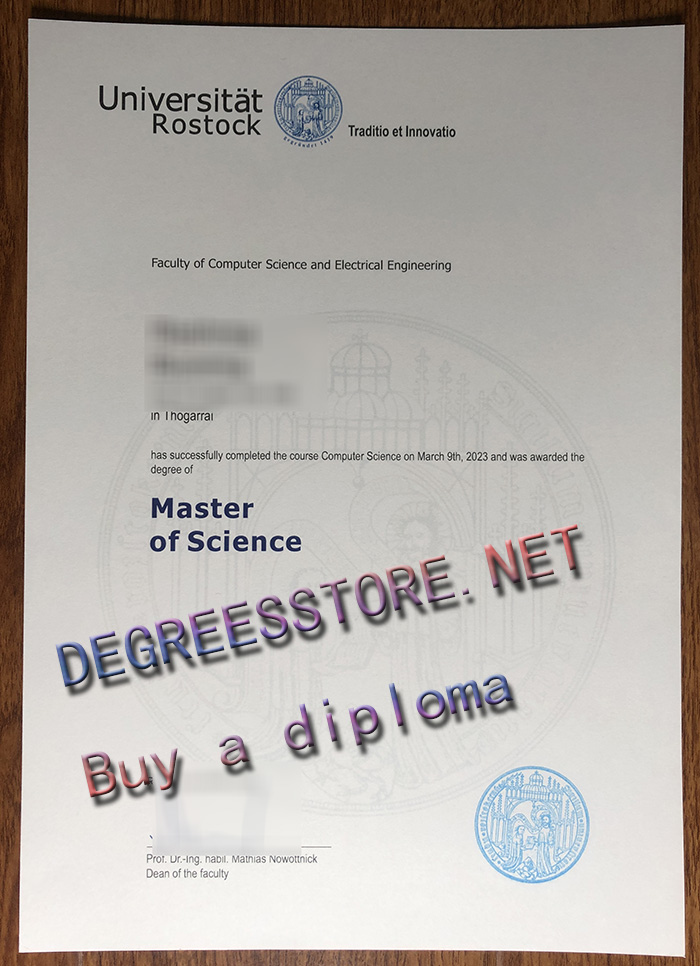
Founded in 1419, the University of Rostock is the oldest university in the Baltic region and the third oldest university in Germany. Make Universität Rostock Urkunde. Buy Universität Rostock diploma. Throughout its more than six-hundred-year history, various “urkunde” (certificates, diplomas, official documents) have been a vital carrier of the university’s academic tradition and institutional authority. From medieval parchment certificates to modern systematically certified documents, the University of Rostock’s certificate system embodies both profound historical heritage and the standardization and internationalization of contemporary higher education.
I. Historical Perspective: Certificates as Power and Privilege
In the context of medieval universities, “urkunde” carried a special legal meaning. From its inception, the University of Rostock possessed the power to issue certificates—not only an administrative authority but also a symbol of university autonomy and academic privilege. The university had its own seal (Siegel), which was used for legal authentication of various certificates, signifying the authenticity and authority of the documents.
The University of Rostock’s seal system includes the Rector’s Seal (Rektorsiegel) and the University Seal (Große Universitätssiegel). The former is used for certifying certificates in routine administrative matters, while the latter is reserved for documents issued on important occasions, such as the awarding of degrees and confirmation of privileges. The University Seal features an image of Christ and the Greif, the city emblem of Rostock, surrounded by the Latin inscription “scrutamini scripturas et discite a me, quia mitis sum et humilis corde” (“Study the Scriptures, learn from me, for my heart is gentle and humble”), a design profoundly reflecting the medieval university’s integration of scholarship and faith.
A certificate issued in 1799 by the Philosophy Department of the University of Rostock is still preserved in the National Library of Ireland. This manuscript document, written in Latin and bearing the university’s original seal, vividly demonstrates the typical form of university certificates in the late 18th century. Such certificates were not merely proof of degrees or qualifications, but also material evidence of the university’s exercise of power as an academic community.
II. The “Urkunde” in the Modern Context: Degree Certificates and Supplementary Documents Entering the 21st century, the University of Rostock’s “Urkunde” system has aligned with modern higher education standards, particularly influenced by the Bologna Process. Today, graduates typically receive a complete package of documents upon completion of their degree, including:
**Degree Conferment Certificate (Urkunde über die Verleihung des Grades):** This is the core document, formally confirming that the graduate has been awarded a specific degree (e.g., Bachelor’s, Master’s, Doctoral). The certificate includes the graduate’s name, the name of the degree awarded, the date of award, and the university’s official seal and signature, representing formal recognition of academic achievement.
**Examination Certificates (Prüfungszeugnis):** Records the student’s grades in various courses or examinations, usually including detailed scores and credit information.
**Transcript (Transcript):** Comprehensively lists the courses taken, credits earned, and corresponding grades throughout the student’s studies.
Diploma Supplement: This is a crucial document for standardization within the European Higher Education Area, describing the nature, level, content, and professional qualifications of a degree using eight standardized components. Its aim is to enhance the international transparency and recognition of academic qualifications. The University of Rostock strictly adheres to the templates set by the European Commission, the Council of Europe, and UNESCO/CEPES to ensure its graduates receive fair academic and professional recognition globally.
It is worth noting that in the University of Rostock’s official documentation, there is a subtle difference between “Urkunde” and “Zeugnis”: the former focuses more on the formal certificate (such as a degree award certificate) conferring a qualification or degree, while the latter focuses more on records of achievements and performance.
III. System Accreditation: The System-Level “Urkunde” In addition to the degree certificates awarded to individuals, the University of Rostock itself has also obtained the landmark “Urkunde”—the System Accreditation Certificate (Systemakkreditierungsurkunde). On June 25, 2018, the university officially completed its system accreditation process, with representatives from the AQAS accreditation body handing over the accreditation certificate.
This accreditation has profound institutional significance. Prior to this, every degree program at the University of Rostock had to undergo an independent, time-consuming, and expensive accreditation process (Programmakkreditierung) through an external accreditation body. With system accreditation, the university is recognized as having an effective internal quality assurance system, enabling it to independently conduct accreditation processes and award accreditation marks to its degree programs.
Professor Wolfgang Schareck, then Rector of the University of Rostock, stated at the certificate presentation ceremony: “The University of Rostock has invested heavily in quality development over the years, implementing relevant procedures and tools to review and continuously improve the quality of teaching and learning. System accreditation is a significant achievement for our university.” This accreditation is valid until September 30, 2024, after which it will require re-examination.
IV. Symbolism and Ritual: The Ritualistic Tradition Behind the Certificate The traditional rituals accompanying the certificate presentation at the University of Rostock are also noteworthy. The university’s ceremonial instruments (Insignien)—including two pairs of scepters (Zepter) and the rector’s official necklace (Amtskette)—are solemnly displayed on formal occasions such as degree conferment.
According to historical records, during the medieval period, graduates swore an oath before a small scepter during doctoral degree conferment ceremonies. This tradition was interrupted in 1968 (during the East German higher education reforms) but was revived after German reunification in 1990. Today, at degree conferment ceremonies, university deacons (Pedelle) in traditional attire carry the scepter, while the university rector wears an official necklace adorned with the symbols of each faculty. These ceremonies not only add to the solemnity of the academic celebrations but also symbolically convey the weight of six centuries of academic heritage to each graduate receiving their degree.
Conclusion: The University of Rostock’s “Urkunde”—whether a 14th-century parchment stamped with a seal or a 21st-century diploma supplement containing eight standardized components—is both proof of academic achievement and an expression of institutional authority. For six centuries, these certificates have witnessed the growth of countless scholars and documented the continuous innovation of this ancient university within the modern higher education system. A certificate connects on one end the academic ideals established at the university’s founding in 1419, and on the other end points to the global academic and professional stage—this is perhaps the most unique value of a University of Rostock certificate.
Download For Windows
 Degree-Cert Form
Download For Mac OS X
 Degree-Cert Form